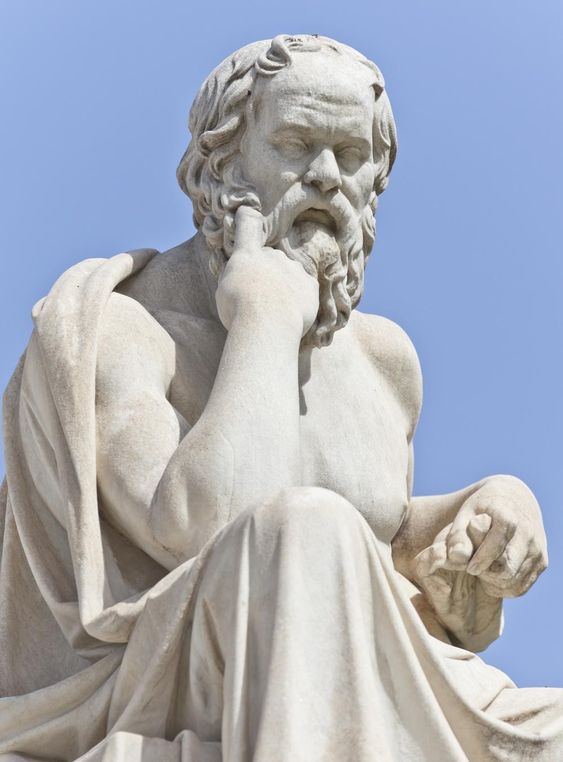
So reading Plato’s dialogues actually got me ramped up to try writing a philosophical dialogue myself. Although mine could never hope to reach Plato’s level, I still had fun nonetheless. Before we begin however, I’d like to point out that this is an amateur work, so there may be many errors which I cannot see yet as I am not nearly learned enough, hence, the title; and one more thing is that while I picked out only one “abstract entity” namely Identity, it does not mean that it is the only one that predicates of many. It can be used more as an example, then a thing that other entities are always reduced to, and a be all end all explanation.
— — — — —
I was walking along the aisles of my local library when I happened upon a friend from school sitting on a table, not reading a book as is to be expected, but staring, staring intensely at stones no less, completely still. Passerbys would figure him to be some kind of eccentric weirdo if he kept at it.
-Oh hello Al- I said, trying to spare him the fate- haven’t seen you much in school, is this where you’ve been cooped up?
-Hm? Hello Erik. Not really, I just got here actually. I’ve been doing other things for the majority of my time absent there.
- Is that so, then, what is this that you’re doing here? — I hinted at the rocks on the table. He looked, and a shine came to his eye as he rubbed his chin, pensive.
-You see, I was ambling about in the market and stumbled upon a rock store. Before you ask, yes, a rock store! And I was looking at all those different specimen when… an epiphany! So I bought two kinds of rocks, two of each of kind. And rushed over where I am left to develop my thoughts. What was this epiphany you ask?
He looked at me eager to continue, as if waiting for my assent. I did just that. Pulled up a chair and sat down.
-Well, as you can see, the fact that I bought 2 kinds of stones, and 2 stones of each of those kinds, hints at the conformities of my inquiry. When I was at that store I was looking at two individual rocks of the same kind and the thought that hit me was: ‘what if each particular rock was infinitely different from its peer?’ I mean, when we look at these two rocks on the table for example — he pointed at one of the two groups — aren’t they not the same? — I responded with a mocking smile
– Bear with me here; are they not two different rocks in themselves?
- Yes.
-Despite being the same kind of rock?
- Yes.
-And when we look at them closely, even if they are alike, their surfaces have different topologies, their colors, howbeit the same color, are of different shades. They were produced at different times, and reside in different spaces, and had a million different interactions and configurations on the macro and microscopic level that will forever be imprinted in time! They could not possibly be the same, from hence unto eternity! Even if you were to make a perfect clone of one rock, the mere fact that they are two different individuals and not one would attest to that. Is that not the case?
- Ha, I guess so.
-So then, we couldn’t by any justifiable standard have distinction among individuals of the same species, and of separate species, because the differences are near infinite. For from what I know, if things are infinitely different, how are they different? Are they not all the same? Paradoxically so, because they are all similarly different.
- Ah, brain f*ck; that can’t be right Al,- I said as rubbed my my eyes- reality seems to testify against you. Look, we’ve got 2 perfectly distinct pebbles of the same kind here.
-And that is precisely my dilemma. At a closer look, we have taken every measurable, observable standard and only found reason of difference. Given that, how is it possible that there are things that pertain to the same group?
- Well, you must be missing something.
-Right! So my question here would be what is it that I’m missing?
- The color brown?
-Don’t be simple minded Erik! My question is what is the color brown! Rather, what is the nexus of predication between the particulars and their class? How can they be one and many simultaneously? We know that the rock is the individual rock different from all others, but we also know that it is in itself a kind of rock comprising one among the sum total of individuals in that kind.
- Is it not just a matter of simple observation? And if you’re looking to answer what colors are, wouldn’t it be the surface that, within the visible light range of the electromagnetic spectrum absorbs all visible colors but the particular color we are dealing with when light hits it? So colors are but small ranges of wavelengths within the frequency range of this spectrum.
-Again, my friend I’m afraid we’ve missed the mark. As inquirers we cannot accept something if it is unaccounted for. Namely that we can see it, that doesn’t solve the problem at all! For as you know, I am asking precisely why it is the case, not that it is the case. And a measurable account of it only keeps the problem place; because, after all, we are still stuck at the point of initial observation by applying certain measurements and associating them with certain colors. And that brings up a transitional issue concerning the infinity of numbers too so…
- I see what you mean… so even if we were to circumscribe some elements under a given set, an unarbitrary justification remains to be given for why those elements were circumscribed to begin with. Because, when I look at the individually measured frequencies I find that many, if not arguably an infinite amount of individually measured frequencies could be taken under a particular color range in the visible light spectrum, and upon closer observations such as these, I only find differences and no similarities; but when I pull back, the similarity is right there!
-Right. And it is not only for this particular case, but more broadly speaking, as what is the nexus which allows for general predication across individuals; because we notice this phenomena not only with colors, as in the blue of surfaces, but also with a whole host of other things, dog of animal , man of persons, 7 of number, and so on extending from concrete to abstract entities.
- Hmm… then I think we are at a standstill here.
-I have a hunch with regards to what this may be…
- What is it?
-Whereas it may not have been clear before, and the simplicity of the answer would chuckle at our toil, I think it is identity.
- Haha! Of course! And look at us flailing around like this.
-But… it’s still not a clear answer.
- Oh? How so?
-Because then, we have to define identity itself. And that, I think, implies digging deeper still.
- Deeper still?
-Deeper still. We cannot define identity fully lest we know where it comes from. We know what it does, but we’ve still yet to trace its roots.
- But let’s first define what it does before that, I think it’s worth it to have the object in mind as clear as possible before digging deeper into the unclear side of things.
-True. Then, we can define identity by virtue of what it does as that which predicates generically and specifically across time. The implications of this is reflected in reality as objects remaining what they are through time, and not at one time being something and at another time being something completely different; a ball cannot stop being at one moment, then become an elephant at another! Generic predication (of the genera themselves, and the individuals) will take care of that. Also this goes further in, with individuals; that would be individual predication of identity, it is what prevents a key and its replica from getting mixed up. Things can be as alike as they can possibly be, but they wont stop being themselves; the fact that they are individuals is a testament to that. And this also shares the same property of persistence throughout time. This, I think, is all that follows from that simple expression A=A, a thing is itself, which is tautological.
- Wait a minute, there are two identities in an object? One is the individual identity and the other is the generic identity?
-Yes and… Something cannot be devoid of generic identity lest there be no differences expressed in reality by way of similarity according to the afore mentioned conundrum of infinitely differing things, which empirical verification attests against.
- Ok, I think we should be ready to tackle the problem now. But first, what do you make of the two id’s in one, problem? To me this seems like a set, subset kind of thing. I mean it doesn’t seem to me that the individual identity can go beyond the scope of what constitutes a given generic identity.
-I don’t see any reason to disagree. Although something interesting to note on that is that abstract entities do not appear to have any individual identities, but only generic identities. So maybe we could build on what you mentioned by saying it antecedes individual identities, such that it predicates itself upon the concrete, circumscribing it, giving it a range of limitations and possibilities. This very act would give rise to or make possible the individual id.
- That’s a non sequitur Al, just because abstract entities have no individual id’s does not mean they antecede them.
-Ho, you’re right. Then i guess i should reformulate the argument… We can both accept that abstract entities are not particular, but generic in nature? That is, that they predicate across individuals?
- Yes, that seems to me to be the case.
-And individual entities are particular and concrete?
- That is so.
-But is it not the case that individual entities also contain generic predication? So they contain two identities as we have just discussed?
- Yes, that is the case.
-So they are complex as opposed to simple?
- Yes…
-That leaves the question then, if individuals are complex, then what is simple?
- That would be… Things which are not compounds, that are by themselves… So generic, abstract entities… And individual ids but…
-But individual identities taken in themselves are abstract. So what is it that’s missing?
- Individual entities are concrete, and any concrete instantiation is related to matter, either directly or indirectly, immediately or mediately.
-Then that means either only generic entities are simple or there is also matter which is simple and therefore we would have two simple things conjoining to form an individual.
-Given this, is it not safe to say that complex things or compounds derive from simple things, that is, the conjunction of simple parts form a complex entity?
- Yes… Yes, then in that sense simple abstract entities antecede complex entities, and that they predicate themselves — the results of which we can observe — on concrete matter, which before any predication, is simple.
- This… If this follows, doesn’t it mean that identity acts upon matter giving it form?
-… By gosh you’re right! If generic id gives rise to the individual id, predicating itself on the concrete by giving it form, doesn’t that mean this concrete had no form or identity before such a thing happened? Thus, serving as further indications to something like purely simple matter.
- Ah, that’s true.
-Now tell me, Erik. Have we not arrived at two different kinds of simple things, each of which are devoid of the other?
- That’s right; the generic, abstract entities and simple matter.
-Does that not mean that we’ve come to opposites? And that abstract entities like identity, in itself has no concrete form, thus lacking in matter?
- Yes
-So it is immaterial?
- That’s what it appears to be.
-That solves it then. We’ve traced its roots, and not only that, we’ve managed to distinguish it from another fundamental building block of sorts, this simple matter. Should we get to the definition then?
- Of course!
-Ahem! Identity, is that immaterial form which is contained by any and all things that can be distinguished. Be it a tree, a dog, a number, a force, a certain rock, an element or a person. Thanks Erik, you’ve helped me think this through quite a bit.
As we reached this point, it looked like he was winding down. But i still felt like we could do much more, I couldn’t help but feel a bit cut short.
- Well, thanks to you too, that certainly took me for a ride… Say, is there perhaps, any other question that may be bothering you?
He looked at me and smiled.
-You didn’t think I would be done with just this did you? We still have much more to explore. But perhaps to do it all today would make things a bit drawn out, so I hope we can meet again to talk like this in the future.
 Autonomous Studies